Credit Unions & America’s 250th Celebration-History’s Lessons

Today credit union  momentum for the 250th birthday of America was interrupted by a Supreme Court decision. The 6  – 3 conservative majority ruled  the President had authority to fire members of independent agency boards established by Congress to be partially shielded from total Presidential direction.

The decision overturned almost 100 years of precedent. It means Trump’s firing of NCUA board mebers Harper and Otsuka will  be upheld by lower courts where the case is on hold.   Trump  may then choose to select two new board members to join his recently nominated Chair John Crews, a republican working in the Treasury Department.  Or he could leave the positions vacant.

This event and its conseqences will be greeted with mixed reactions by credit union supporters.

But history can also provide us perspective to the current moment.  And more importantly, point the way forward.

Not the First Time for President’s Firing NCUA Leadership

On March 10, 1976, Administrator Herman Nickerson, Jr. of the National Credit Union Administration testified before the Senate Banking Subcommittee on Financial Institutions (chaired by Senator Thomas McIntyre) regarding S. 1475. The hearing focused on proposals to restructure the NCUA from a single-administrator agency to a multi-member board.
Nickerson testified that a single-administrator structure left the agency highly vulnerable to political pressure, stating that under his “day-to-day” tenure “you don’t know whether you’re going to take a position that would be your last day in office or not”. He argued that a three-person board would provide better long-term stability and continuity for regulating federal credit unions. 
In the hearing Administrator Herman Nickerson, Jr. was asked about his vulnerability to being fired, and Senator Thomas McIntyre confidently responded by assuring Nickerson that “it would never happen”.
Merely two hours after the hearing concluded, President Gerald Ford summoned Nickerson to the White House and fired him without cause.
March 19, 1976 Office of the White House Press Secretary

————————————————————

NOTICE TO THE PRESS

The President has accepted the resign.,tion of Herman Nickerson, Jr., as Administrator of the National Credit Union effective upon the appoint ment and quaJification of a succes sor. He was appointed on September 15, 1970. There is no successor to announce at this time.

The Three Person NCUA Board Legislation Approved

Senator McIntyre was reportedly shocked by the firing. He used the incident as a stark, real-time example on the Senate floor to successfully argue that the NCUA must be restructured into a multi-member independent board to protect its leadership from sudden political retaliation. 
This hearing served as a major catalyst in the legislative shift that eventually established a multi-member, bipartisan board to govern the agency. 
(Sources:  Rosemary Hardiman, then a reporter for  CUIS, Gerald Ford Library, AI search for hearing summary)

Today’s Response and the Future of Credit Unions

The three person, independent NCUA board was intended to moderate the extreme policy fluctuations if every President could choose to appoint new regulators who would then implement whatever policy  priorities he wanted.
In contrast,  the theory supporting independent agency status was to ensure experienced, knowledgeable board members  would be appointed to protect and promote the public interest not  partisan political agendas.
Only two NCUA board members could be from the same party.  In theory this assured some public debate or even opposition in policy and agency oversight.
The theory worked for NCUA’s first two chairs, Larry Connell and Ed Callahan. Both were experienced state regulators with direct knowledge of credit unions.   While other board appointments would appear more like political sinecures, agency leadership was in expert hands.
The assumptions of industry expertise and apolitical Chairs ended with the appointment of Senator Roger Jepsen (defeated in a re-election effort) to succeed Callahan in 1985.  Rarely have future Chairs had regulatory or credit union experience with the exception of JoAnn Johnson from Iowa.
She had been Superintendent of credit unions for the state and joined the NCUA board in 2002, becoming chair from 2004-2008.  After returning to Iowa she was again Superintendent of Iowa’s credit unions until her retirement in May 2017.
The vast majority of NCUA board appointments have had little to no credit union affiliation.  NCUA’s board appointments have been filled with former congressional or agency staff members seeking continued federal employment. Some have had strong professional credentials (McWatters) but virtually none had prior credit union associations or knowledge.
Credit unions have long abandoned efforts, individually and as a system,  to identify and promote knowledgeable individuals for NCUA positions.
 Both democratic and republican administrations have used NCUA board seats to reward political loyalists versus those with credit union credentials.
In pactice the theory of the independent agency with expert leadership acting in the best interests of credit union members has rarely happened  Instead  NCUA board appointments have become a backwater for those seeking the prestige, or sometimes the spoils, pf a political appointment.

The  Future of Federal Credit Union Regulation

Just as in 1976, there will be a reaction to the current political excesses and  NCUA’s increasing impotence  shaping the future of the cooperative system.
The Agency may become a department with a single administrator within Treasury, like the OCC.  The NCUSIF merged with the FDIC.
The future may be a more cooperative and innovative state support system.
NCUA may be caught up in a sweeping federal government reform post election or post Trump.
Following yesterday’s precedent in this week leading America’s 250th ,  it is useful to express our future hopes for the country and cooperatives in music.  While this was not my original choice for today, it seems to be one approach to future events when  asking  Who shall wear the starry crown?.
(https://www.youtube.com/watch?v=d2LjgalcsVI)


Credit Unions Learning from America’s 250 Celebration

This week ends with the 250th July 4th national birthday celebration.

It is a moment of community consequence for a country founded on ideals and a vision begun  with the words all men are created. .  .

Our implementation of this founding declaration has been uneven. Even with ever increasing economic prosperity that leads the world.

So this milestone celebration creates ambivalent feelings for many who believe our vision is falling short in critical areas of our national life together.  For example, those whose families came to America from far away and many who believe immigration has been a source of America’s international standing and internal strength.

The Credit Union Parallels

Likewise there are strong parallels in today’s credit union story which spans  less than half the country’s.

The movement was founded on an ideal that cooperatives could be an alternative to the for-profit capitalist motivation which viewed  consumers as profit centers.

Credit unions’ financial success is impressive.  These institutions are now the second largest depository system in the country with  $2.5 trillion in assets and generations of members numbering in the tens of millions.

However, as financial success is achieved, some ask if the system has lived up to its aspirations.

For in America today, as Jim Blaine stated decades ago, “those who have the least or know the least, pay the most for financial services.”

There have been significant contributions by the movement’s founding  mothers and fathers that have given credit unions a legacy to be proud of and a system that can do great things for individual members and  their home communities.

But as in the country’s celebrations, there are concerns that the founding ideals are being lost.  There is increasing evidence that in some credit unions, and as common practice in many, the impact  is to actually widen the gap between those who are well off and those  who live on each pay period’s income.

Reasserting the Things that Make Us Special

To address any ambivalence you may feel  about either our country’s or our movement’s histories, or current challenges, I want to select music that honors our aspirational goals as a nation and as individuals.

When words are sung, their meaning is amplified and transformative.

Visions never die.  They lie dormant until leaders arise to challenge our ambitions, to call us to our higher selves and  to ignite hopes that spark everyone’s individual pursuits–of life, liberty and happiness.

A Credit Union Anthem

Here is an anthem for the credit union movement’s collective purpose: Hard Times Come Again No More.  Written by Stephen Foster in the 1850’s, it addresses the cycles of economic reality and the collective willingness to help each other when these circumstances occur.

(https://www.youtube.com/watch?v=5Fddr0CTflQ)


The Limits of Virtual Meetings and Relationships

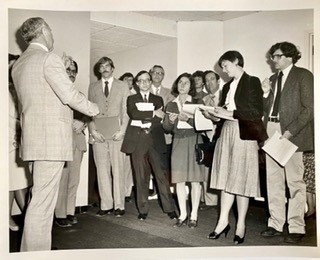
One of the vital initiatives  Ed Callahan took as Chairman of NCUA was to take the monthly public board meetings “on the road.”  Over a period of two and half years, public  board meetings wewre held in all six regions. Often in locations that coincided with already planned league or national conferences.

For example the July 1982 board meeting was held in Chicago  at the same time as NAFCU’s annual meeting. That was the same weekend that the Penn Square bank failure occurred.  Because of credit union investments with uninsured Penn Square Bank CD’s, the Board meetingt attracted widespread interest.

Constituents Meeting Their Regulators

The purpose of these outside the beltway public events was to give credit unions a chance to attend meetings and see the board at work. In addition the visits often involved credit union conversations, local newspaper interviews, all which raised the profile of the credit union system and  the movements embrace of deregulation. The visit from DC raised the profile of an areas  credit unions and their contributions to their  their communities.

These interactions created awareness of NCUA’s activity and leadership.  It gave senior DC based staff direct conversations with credit union leaders on their home turf and in the various economic circumstances around the country.

Each board meeting was followed by an open press conference where Chairman Callahan and staff would answ questins from the media and credit union attendees.
Today’s Public Meetings

Yesterday’s NCUA board meeting was broadcast live, an effort going back years and accelerated by COVID’s cancellation of inperson events.  It is a practical way for many to watch a distant public meeting live or later by video.  While interaction is not sought, the slides and other presentation data can be downloaded by viewers.

Decades later this board live broadcast have replaced the on-the-road visibility which was discontinued after Chairman Callahan’s tenure ended in 1985.

But does it make a difference whether Board meetings are viewed via digital broadcast or in person in a physical serrting?

Why In-Person Matters

Tim Calkins is a marketing professor at Northwestern University’s Kellog Management School.  He uses remote learning sessions in both his class room lectures and private consulting assignments.

The Covid epidemic nade virtual delivery a necessity.  The use of remote, live virtual meetings has continued as an accepted option for many organizational inernal management meetings as well as public events such as member annual meetings.  Sessions can be  interactive and seemingly similar in content to in-person events with the same purpose.

Moreover, virtual  events can be a more effective use of time by both presenter(s) and participants.  No travel, recordings can be made at once, and AI edit summaries produced.  The reach can be  unlimited by audience size, location, or time zone.  What’s not to like?

Following is Tim Calkins’ assessment of why in-person still brings benefits that virtual sessions cannot duplicate from an article he posted last week:

The Project
Over the past quarter, I’ve had the chance to work with a leading company on a competitive situation. There were new entrants in their industry and the company was formulating a response. This was partly a strategy question and partly a political question: getting the team and the senior people on board.

I did the project remotely. I taught a class session for the team on Zoom, had multiple phone calls and then participated in two team planning sessions in a hybrid format.

The Problem
The project is winding down, and I’m not feeling great about it. I think I made a positive contribution, but not as much as I could have, for a very simple reason: I wasn’t there.

This wasn’t a problem for the class session; I can teach effectively on Zoom. It was definitely a limitation in the work session.

There were lots of problems with being remote. The first issue was that I couldn’t hear much of the conversation; I was picking up about 60% of the discussion. I could follow along but I missed some of the context. Then, it wasn’t easy for me to jump in; I didn’t know how I was showing up in the room, so I found it awkward to make a comment. I also couldn’t read the room. I couldn’t see how my comments were being received. Were people nodding and agreeing? Or rolling their eyes?

Perhaps most important, I wasn’t there for the open times: before the meeting, during the breaks, after the meeting. These liminal times are critical when it comes to influencing and building relationships. During a break one can follow-up on a comment, ask a question to clarify a point or just build a relationship.

In hindsight, I should have insisted that to take on the project, I had to travel to the company for the key meetings.

I didn’t do this because my schedule has been hectic, so travel would not have been easy. And the company didn’t request it; they routinely did hybrid and remote meetings.

The Learning
My takeaway is simple: don’t do a strategic project if you can’t be physically present.

I don’t need to take on company projects; I only accept a new program when I think I can add value and will learn something.

Going forward, I’ll pick and choose with a bit more care. I’ll still teach remotely, but I’ll only do strategy working meetings when I can be in the room.

The Opportunity for NCUA or Any Board with Public Accountablity

Might a new NCUA Chairman revisit the idea of taking Board meetings on the road?  Such events could accelerate relationships, learning about local credit union circumstances and most importantly, building trust that can only be created person to person.

Kyle Hauptman’s Final Call as a One-person NCUA Board

If Senate hearings proceed as planned and Trump’s nominee for the next NCUA chair is approved, todays board meeting will be Hauptman’s final time as NCUA’s solo leader.

As he departs,  NCUA situation is like a suitcase without a handle, or wheels.  The agency is being led by a single person, not the prescribed board.  Its operataing capacity has been reduced by a DOGE induced, staff designed elimination of 20% of its workforce.

Flooding the Zone

Hauptman’s major initiative has been to “flood the zone” with over a dozen regulatory revews  addressing such urgent issues as banks purchase of credit unions versus the operational realities of credit unions purchase of banks.

The agency continues to publish  a repeating loop of bureaucratic processes such as banning people from further activity in credit unions or periodic issuance of credit union data.  When the nexr administrator opens the suitcase, he is likely to find little addressing critical cooperative  or administrative management issues, e.g. the effectiveness of agency examinations.  One indicator is the growing list of summary liquidations from sudden discoveries of significant, long term large operating deficits.

Hauptman has held board meetings “only as necessary.”   His solo tenure of almost 15 months is an example of the shortcomings of a single administrator  without either credit union context or regulatory experience.  However that resume gap is not unique to him.

The Knowledge GAAP

Such appointments, especially as Chair,  mean the learning curve for new leadership is extended and  there is total dependence on the bureaucracy’s agenda.  More critically, there is a lack of relationships and knowledge of the credit union system and its different leadership elements.   It narrows the understanding of issues from both an historical perspective as well as key differences about current system priorities.

The result is that the cooperative system’s uniqueness and capacity are underestimated.   Critical issues are viewed from the more familiar perspective of the banking system.  And the siren call of some lobbyists for the false standard of “parity” becomes a basis for decisions.

A Vacuum in Dual Regulatory Oversight

There has been a vacuum in regulatory leadership at both the state and federal levels for some time.  It is hard to think of a comment or action taken in either system that addresses important trends and issues in a considered manner. The issues silently observed include purchases of banks, the merger frenzy driven by CEO payouts, the absence of real member governance rights, and zero transparency in credit union strategy and cooperative accountability to owners.

Leading NCUA is not a one-person job,  It requires  both administrative oversight plus  constant  dialogue and initiatives with credit unions, collectively and individually.

An Empty Suitcase

Right now NCUA’s suitcase is pretty light.  It may be easy to lift without a handle.  But sooner or later the movement will experience the consequences of a regulatory system that  has no cooperative agenda or engaged oversight.

As the regulatory grasp and  staff effectiveness erode, this will  create a series of reactive responses to ideological/political priorities or to inevitable external problems or crisis.  The system will be at the mercy of events without informed and committed regulatory leadership.


A Different COOP Growth Mode or The Real Thing?

In  the CEO’s words:  At Good Neighbors we do not have a “growth” strategy; we have a “strength” strategy. Which is to say that we are not looking to increase members by numbers but instead are trying to grow members intentionally by focusing on those who are philosophy/mission aligned and who want to participate as owners. This is because we no longer have exclusively our closed SEG group and are instead tasked with building our own common bond.

Co-op fest (Buffulo) is a great opportunity to meet others in the area who are like-minded and tell them about the credit union. My friends at Cooperation Buffalo call these people the “coop curious” – people who are open and interested in learning more about cooperatives.

We participate in the Cooperative Fellowship.

From that website:

Cooperative Changemakers: A Community Power Fellowship is an intensive 11-week training for cooperative entrepreneurs and advocates building an economy that puts people first.

Cooperative Changemakers aims to activate and empower those interested in joining and contributing to Buffalo’s growing cooperative community. The Fellowship fosters collaboration, knowledge sharing, and the development of skills essential for building democratic power in our communities.

Participants have the opportunity to engage with local cooperators and develop actionable plans to bring their visions to life. The Fellowship seeks to cultivate a vibrant and engaged community of cooperative entrepreneurs and advocates, driving positive social and economic change in Buffalo.

Source: Thank you Emma Smalley, CEO, Good Neighbors Credit Union