St. John’s Norwood Parish, an Episcopal church in Chevy Chase, MD, has a lay group that provides direct help to Ukrainian citizens in that country’s war with Russia.
They partner with St. Andrew’s Ukrainian Orthodox church in Silver Spring, MD, which receives direct requests for specific special projects as well as regular health and welfare shipments. Last November, the two churches held a fundraiser dinner prepared by St. Andrews to outfit a car as an ambulance for emergency evacuations from the front lines. It seemed like a stretch to raise $15,000. But the goal was met and within 30 days the pictures came back of the vehicle being retrofitted.
When One Becomes Six
Just today we learned that this effort has sparked a new process that has led to six ambulances being made from this one donation. Here is the story as told by Sandie, who leads St. John’s Ukrainian support effort:
There has been a further development on the evacuation vehicles that St. John’s was able to purchase with the proceeds from our Third Sunday Ukrainian Supper, last November. I have just been informed that 2 more vehicles have been found and completely refitted for evacuation, rescue and transport. We now have 6 vehicles, made possible through our donations!! SIX!!
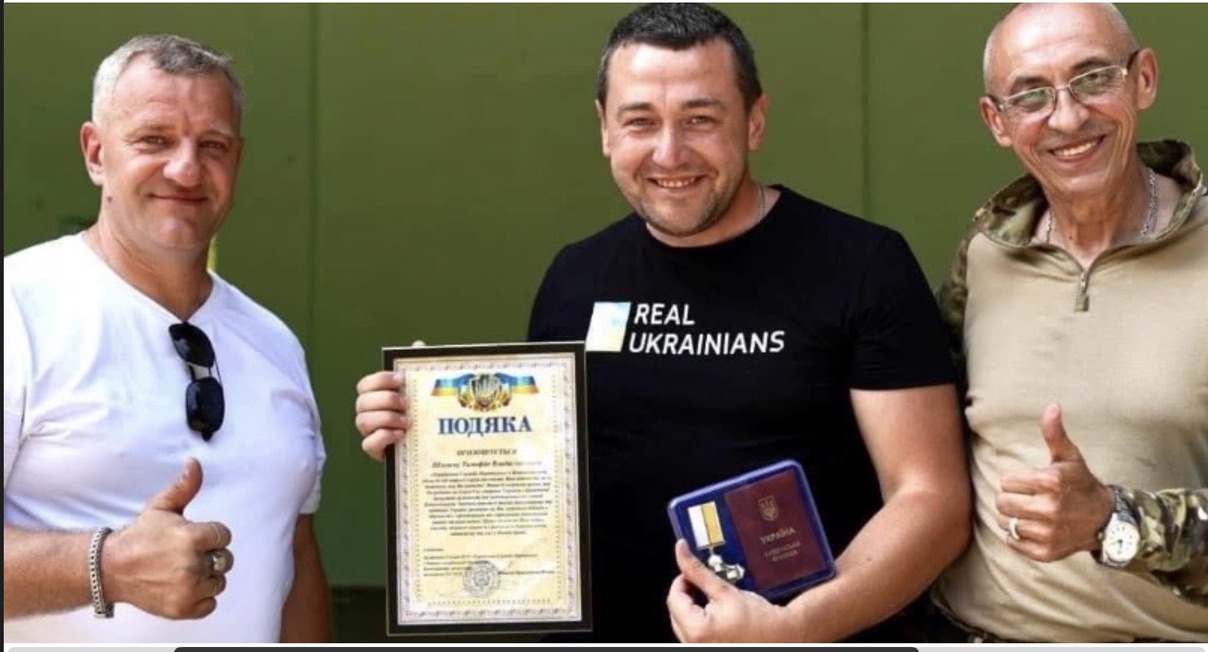
You are probably wondering how on earth $15,000 could be stretched so thin that 6 vehicles could be found. So, I did some digging. There is a very resourceful gentleman in Zhitomyr who founded an organization “Real Ukrainians”, dedicated to sourcing and supplying vehicles, equipment and medical supplies. He is well known to St. Andrew’s and worked with them on many projects.
Tymofii Shlieniev has been able to get donated vehicles and his team completely refurbishes and refits each one according to needs. Each vehicle is armored and most are all terrain capable. Basically, our $15,000 provided the complete refurbishment of 6 donated cars and vans and converted them into armored vehicles, capable of rescue, medical evacuation and transport of supplies and equipment in front line areas.
The photos below show Tymofii receiving recognition for his work in Ukraine. The second photo lets the drivers, medics and volunteers know that wherever these vehicles go, in whatever emergency circumstances, St. John’s is with them!
It’s amazing what putting your faith in God and trust in dedicated, generous hearted men like Tymofii can accomplish!
Sandie
The Multiplier Effect on the Human Spirit
The multiplier effect is an economic concept where an initial change in spending or investment leads to a larger total increase in national income due to downstream recirculation of the funds. The process is a fundamental basis for government fiscal policy. Increased spending during a recession is the primary effort to jump start a slowed economy.
But the theory also describes the multiplying impact of human activity. Hope stimulates hope. This belief inspires innovation, sharing and common effort.
Initiating such efforts can be ignited by just a leader’s public affirmation. After Russia’s invasion aimed to capture Kiev the US offered to evacuate President Zelensky. His reply, “I need ammunition, not a ride.” The country, and the world, rallied to this example of courage.
In the above example, the partnership of these two local churches has provided a means for ordinary Americans to directly support Ukraine’s people directly.
For hope begets hope. It stimulates creativity, imagination. Individual contributions become group efforts. The joining together becomes a movement. This is how change happens, threats countered and people organize for a better shared future.
The Credit Union Model and the Multiplier Capacity
This common purpose for change still drives many credit unions. For others the status quo is fine and the future priority is to combine resources.
If cooperatives are to regain their movement ambition in this era of financial success, a new leadership vision is needed. A belief that members should join to create more economic justice, not just another financial option.
That by joining together, and combining resources with others, the outcome is not merely additive, i.e. more assets. Rather, the multiplier effect results in bringing others together creating stronger more resilient communities.
The human spirit’s joined possibilities are as old as the story of the loaves and fishes, and as urgent as an appeal for a single ambulance.
When people mobilize in common cause there can be no stronger foundation for progress. Every person has within the spirit of greater possibilities, just like a mustard seed. Together we create the soil in which this spirit can grow.
Sometimes it is immediate and sixfold. In other, longer timelines, it may be building cooperative options, started with only human capital, for those left behind by profit focused services.

 The SECU Board is determined that SECU members – that means you! – should not have the ability to reasonably self-nominate to serve on the Board; nor should members have a choice among candidates. In other words, your vote as an SECU member-owner will no longer matter; your vote will not be counted. . . (l