Current Whole Bank Purchases Illuminate Core Issues and a Glaring Deficiency

The five whole bank purchases by credit unions announced in 2021 illustrate the importance of answering the ten “transaction level” questions posed yesterday.  Each instances adds more complexity to those common issues . A review of these four credit unions’ actions follows.

  1. This month, Wings Financial Credit Union completed the acquisition of the $72.4 million Brainerd Savings and Loan, a Mutual Federal Savings Charter.

This in-market acquisition’s primary difference is Brainerd’s mutual ownership structure.  Brainerd and Wings cannot legally enter into a merger agreement, so the transaction is structured as a branch sale of Brainerd’s sole office, with a purchase and assumption of assets and liabilities, a voluntary liquidation of Brainerd, followed by a distribution of any residual assets to Brainerd’s mutual depositors.

Completed early in June, both parties have kept details private.  There have been no disclosures of valuation for assets and liabilities nor how the well-capitalized mutual’s reserves will be distributed.

Secrecy creates a situation lacking accountability.  How should depositors’ collective wealth be allocated to executives who facilitate the sale?  For the directors of both institutions, what is their fiduciary responsibility for disclosures to their owners?

Converting mutual banking charters serving the general public into private sales with no disclosure is an unsettling precedent. Because CEO’s and boards manage common wealth, respect for the values of honesty, openness, and trust are a vital factor of mutual and co-op design.  How will Wing’s leaders inform their member-owners about this use of their reserves and the benefits they should expect?

2. Vystar’s purchase of HSBI is the largest bank acquisition by a credit union to date.

Heritage Southeast Bancorporation, Inc. (HSBI) serves as the holding company operating three legacy brands Heritage Bank, Providence Bank and The Heritage Bank in their historical home markets. The holding company oversees $1.6 billion in assets and 22 branch locations across Southeast Georgia, through Savannah and into the Greater Atlanta Metro area.

The transaction combining these three previously independently owned banks was completed in September 2019.  Their independent business models focused on local commercial and real estate loans with virtually no consumer lending.

These mergers are the primary reason for the five-year growth shown below in Heritage bank’s assets:

Avg Yearly Asset

2016 = $409m

2017 = $445m

2018 = $490m

2019 = $1.055b

2020 = $1.457b


Its Pretax Operating Income Trails the Peer

2016 = 0.49% ROA (6th Percentile vs. Peer)

2017 = 0.92% ROA (14th Percentile vs. Peer)

2018 = 1.21% ROA (29th Percentile vs. Peer)

2019 = 0.37% ROA (1st Percentile vs. Peer)

2020 = 0.41% ROA (3rd Percentile vs. Peer)

When HSBI’s combination of three separate banks was announced in the fall of 2019, two CEO’s explanations were included in the newspaper story:

The combination is expected to offer shareholders several benefits, including ownership in a larger, more diversified and scalable company that has increased capital flexibility and operational effectiveness and efficiency, as well as improved liquidity in their shares.

“We look forward to continuing the ‘customer first’ cultures of each of our legacy organizations, while also providing our shareholders with a more marketable stock,” said Brad Serff, the President for the legacy Providence Bank division. 

“There are advantages to the merger,” Smith, CEO of The Heritage Bank said. “As a larger institution, we’ll have better resources, we’ll have more employees together obviously, and together we’ll just be stronger. We’ll have more effective buying power, we’ll gain efficiencies. 

Smith emphasized that on the client side, Heritage Bank will be able to offer a wider array of products, and the internal changes happening will affect the consumer or client in a minor way, if at all. Everybody worries about when banks do this, Smith said. But we’re the oldest bank in the area, and everyone else has done this.

“From a client standpoint, it should not change anything as far as the products and services we offer,” Smith continued. “In fact, the services could be enhanced. That is our intention. As far as what the client will see—the reality is, our branches are all staying the same, and the people are staying the same.”

Now all those assurances except one would appear unfilled.  HSBI stock certainly became more marketable, and fast.

Vystar is paying 1.80x tangible book value ($15.16 per share at 3/31/21) or $196 million for this bank combination that had yet to be fully implemented. The stock price jumped from $14.50 to $25 when the $27 share offer was announced. The market valuation prior to the announcement was only $105 million. This offer is a windfall for the new holding company’s shareholders.

The purchase price is approximately 22% of Vystar’s March 31, 2021, reserves. How will this transaction affect its net worth ratio now and in the future?

In addition to the financial issues are the challenges of an out of area purchase. HSBI’s headquarters in Jonesboro, GA, is 400 miles from Vystar’s headquarters.  The credit union has no brand recognition, legacy, or existing networking advantages in these new markets.

The HSBI consolidation was less than 18 months along. Each bank had retained their local identity.  Now another transition is needed for employees, customers and the communities served.

Small town banks, especially in commercial lending, are in the relationship business.  Will those advantages continue?   What benefits will Vystar bring to these markets which had just gone through an ownership change?

Yahoo Finance compares HSBI’s current stock price ($25 per share) to its earnings for the trailing 12 months.  At March 31 this ratio for HSBI’s  stock price is 177 times these trailing earnings, a stratospheric number.

Offering approximately two times book value for a company assembled a year and half earlier with a limited performance record seems sudden. Vystar’s challenge will be to convert their substantial premium and  three-bank unfinished combination into a competitive benefit for the credit union and its members.

  1. Lake Michigan Credit Union purchases Pilot Bank and its six Florida branches for $97 million.

The early June announcement of the credit union purchase of this Tampa-based bank caused the per share price to jump from $4 to $6 in less than a week.  At the agreed price of $6.25 for the 15,483 shares, this equates to a total value of over 1.8 times the bank’s March 31 book value.

Pilot bank focuses on commercial and industrial loans with a specialty in aircraft financing.   This will bring Lake Michigan’s west coast Florida branches to 19 (plus 46 in Michigan.)  The credit union says this further expansion into Florida is motivated to serve members who visit there in winter.

This transaction raises a similar set of challenges as for Vystar when expanding outside a credit union’s long time operational base. Tampa is 1,250 miles from Grand Rapids. Will the Florida customers and borrowers see the Lake Michigan brand as relevant to their local circumstances?

The price is 150% higher than the total market valuation before the announcement which makes the financial return especially important for this out of area investment.  The total purchase price would be approximately 10% of the Lake Michigan’s March 31, 2021, reserves.

  1. GreenState simultaneously purchases two banks with total assets of $1.1 billion.

On a credit union performance scale of 1-10, GreenState Credit Union would rank an 11.  Their numbers and service  are almost without peer.  This makes their  announcement on May 25 to buy two banks simultaneously unusual given their extraordinary in-state record.  One acquisition is in suburban Chicago and the second in Omaha.

Oxford Bank and Trust is headquartered in Oakbrook, Illinois and has six branch locations in Addison, Naperville, Plainfield, and Westmont. The press release says Oxford has assets of $730 million, with $405 million in commercial and consumer loans, $635 million in deposits and $71 million in capital.   The two headquarters are 220 miles apart.

Premier Bank established in 2011 is a locally owned, community bank serving the Omaha and surrounding areas, as well as the Nebraska City community. The bank has three branches in Omaha, and one branch in Nebraska City. At March 31, the bank reported $383 million in total assets with almost $40 million in capital.   Loans are primarily commercial and real estate.  GreenState’s head office  is 246 miles  from Omaha.

Both banks are privately owned so there are no public stock quotations.  No financial details were released.  However, the two institutions’ book value from FDIC reports is $111 million at March 31.  Both are stable, high performing and supportive of the sale to a credit union with which they apparently have no prior experience.

Assuming a purchase price of 1.75 times book value for the banks (no numbers were announced), that would equal $195 million or 27% of the credit union’s March 31 reserves.

GreenState raised $20 million of subordinated debt in the 4th quarter to add to its reserves.  Was this in anticipation of these purchases? Was this use in the supplemental capital application filed with NCUA?  If yes, that would seem to open a whole new purpose for supplemental capital.

These two out of area mergers raise the same questions as the previous out of state transactions. The GreenState brand is new in each market; both banks’ balance sheets focus on commercial and real estate, not consumer loans.  Implementing two on boardings, conversions and integrations at once will require an intense operational focus for the next 12-18 months.

“Market-based Transactions” & Other Observations

In early 2020 NCUA proposed changes to its rule (part 708(a)) on bank combinations. The proposal, currently in limbo, received almost 40 responses.

NAFCU’s comments on the proposal were supportive, stating that this is just the market at work, describing the bank’s decisions as “the best option available for consumers:”

Combination transactions are voluntary, market-based transactions that must receive approval from both the NCUA and the Federal Deposit Insurance Corporation (FDIC) and as such, should not be subject to overly prescriptive regulatory requirements that could put these transactions as well as affected consumers at risk.

Bankers’ baseless attacks on the credit union industry regarding the sale of banks to credit unions have raised false alarms—these are voluntary, market-based transactions, wherein the banks’ board of directors are voting to sell to credit unions as the best option available for consumers.

However actual events are more complicated than this defense.  Each transaction above for which the sale price is known is a significant commitment of capital (10-22%) and major operational undertaking. Unlike organic growth initiatives, these “opportunities” are brought to credit unions by consultants or brokers reaching out for ready buyers. The serendipity nature of these offers should remind that they may or may not readily match a credit union’s market vision or operational readiness.

The examples where a sale price is disclosed suggest that bank owners have mastered the art of buying low and selling high. This raises a question: why would these shareholders sell for cash if they believed their bank had this inherent future potential?

A former credit union CEO commented on these events: Credit unions enter negotiations with the idea of buying market share and bragging rights.  Who brags about buying a trophy?  Banks arrive at the table with one thing in mind– ROI.

What alternatives for organic growth are being pushed down credit unions’ to-do lists? Are GreenState’s in-state opportunities and appeal so saturated that venturing into suburban Chicago and Omaha are a better option for members?

Each credit union has previous purchase transactions. What were their customer retention  outcomes?  How long was payback on these investments?  In what way did these experiences benefit current members?

Others who have evaluated these opportunities claim that they come down to a simple buy-versus-build financial calculus when considering a new market:

“When I calculated the cost and effort to build my way into a new market with high barriers to entry, I proved to myself that the costs associated with acquiring a turn-key, profitable book of business was in the ballpark.”

An Unsettling Lack of Transparency

What is common to all five purchases is the lack of information to evaluate the transactions on impartial, objective criteria with market comparisons.

Relevant details are not disclosed before the deals are closed as occurs in most bank-to-bank purchases.  Such public scrutiny can dampen excesses that may occur when core facts are not disclosed.  This secrecy also prevents the credit union system from learning from these examples.  The expertise relied upon now is at best conflicted as their compensation primarily comes when closing the deal.

These purchases have significant consequences for members, their credit union, the customers acquired and the employees and communities where the banks are operating. The credit union’s value proposition should be in writing and available to all affected parties.

Because coops manage “common wealth,” transparency is a critical leadership competency.  Without relevant information, confidence in these transactions is difficult to support.  Sooner or later, this lack of openness could lead to disappointing outcomes—but the sellers will have already taken their money to the bank, so to speak.

Chapter III will review what the member-owner’s.role should be in this use of their collective capital. They are not only owners but also the beneficiaries, or losers, should these deals turn out to be poor decisions.
The Corporate Resolution: Hard Truths and the Need for an Objective Lookback

The most disastrous event in the 110-year credit union story, the corporate crisis of 2008/9, has created its own myths and interpretations. The good news is that most credit unions successfully navigated the burden of paying billions of unneeded premiums.

The downside is that there has been no change in NCUA’s unilateral ability to impose its internal resolutions on problems unchecked and lacking objective data.

Edwards Deming, the founder of the quality improvement movement, stated: “Without data you are just another person with an opinion.” Opinions of the corporate events have always been plentiful and often predictable, from 2009 to today.

The latest March 2021 AME quarterly financials show NCUA’s 2010 loss forecasts and current outcomes differ by over $20 billion.

Common sense requires an independent factual commission analyze the entire event so this kind of catastrophic mistake never happens again. This is not an exercise in 20:20 hindsight. It is to prepare a full record from contemporary data, documents and participants to prevent future ruinous system outcomes.

Here’s the latest data and comparisons with NCUA’s forecasts.

AME Surpluses Grow to $3.125 BN

Total projected distributions to members of four of the five corporates now total $3.125 bn. This is an increase of $95 million from three months earlier.

Credit union shareholders in Members United and Southwest Corporate will receive 100% of their capital, plus liquidating dividends projected at $14 million and $307 million respectively, for a total of over $1.3bn. Both reported millions in regulatory capital in their August 2010 call reports before being taken over by NCUA.

WesCorp’s Deficit at $2.175 Bn

Only WesCorp shareholders will receive no distribution on their $1.114 bn of member capital. NCUA estimates the NCUSIF loss on WesCorp’s estate will be $2.2 bn. (AME: B4 Due to government)

NCUA’s Liquidation Expenses Exceed 10 Years of Operating Budgets

Section B 1 of the AME financials, “Liquidation Expenses,” reports total operating costs paid from each of the five estates of $4.786 bn. Subtracting expenses for legal recoveries (line 15) of $1.258 bn, NCUA has spent $3.528 bn administering the corporate resolution plan.

This net amount exceeds all of NCUA’s combined operating budgets from 2010 through 2020 in its oversight of 5,000-6,000 credit unions, the NCUSIF and the CLF.

Moreover, these “expenses” do not include realized losses charged to the AMEs of over $1.0 bn. NCUA incurred those additional losses by selling non-legacy, fully performing investments immediately after seizing the credit unions in 2010.

Total Surplus Approaches $6.0 Billion

NCUA boasts of the net legal recoveries of $3.8 bn. However, that amount would just pay for NCUA’s TCCUSF administrative expenses with only a $200-$300 million overage.

The growing combined surpluses of nearly $6.0 bn from the AME estates and the TCCUSF merger are from the “legacy” investment payments of interest and principal. Expected losses forecasted in 2009 years into the future, and expensed from capital, were billions in error. Instead of recognizing losses as incurred, they were written off all at once based on faulty modeling assumptions of future cash flows over the securities’ remaining lives.

TCCUSF Forecasts Billions In Error

When the TCCUSF was merged on October 1, 2017, its entire surplus of $2.562 million was transferred into the NCUSIF. However, when the liquidations commenced in 2010, NCUA projected a loss of $8.3 to $10.5 bn in the TCCUSF. This one aspect of the resolution plan’s outcome was in error by $10.6 to $13 bn.

NCUA estimated the range of total resolution costs after seizing the five corporates at $13.9-$16.1 bn. Projected recoveries were $0. The $5.6 bn extinguished credit union capital was gone forever. Additional TCCUSF assessments from credit unions ranged from $7.0-$9.2 bn.

These total AME estimates were off by over $20 billion when adding the growing surplus to this loss forecast.

These Resolution Costs Detail estimates of July 2010 were disclosed only after the seizure and liquidations were undertaken. At the same time the KPMG audit of the TCCUSF (note 6) projected a total loss of $6.4 bn at December 2009 across the entire corporate network. This audited loss provision estimate was not released until December 27, 2011, or 15 months after the liquidations commenced.

In contrast, at June 30, 2010, just prior to the five seizures, the 27 corporate call reports showed the entire system reporting gains in reserves of $260 million and significant reductions in AOCI (all other comprehensive income) of over $8.8 bn versus June’s 2009 totals.

Every corporate reported improving financial results as financial securities recovered from the depths of the market dislocations in early 2009. Instead of recognizing these positive trends, NCUA imposed a second crisis on the system by liquidating the five corporates.

The Members United Example

Corporates and the entire economy were on a visible recovery trend when NCUA initiated its September 2010 liquidations. One example: Members United had expensed $600 million in estimated OTTI credit impairments, but had incurred actual losses of only $95 million according to its final call report on August 2010. Its reported changes in the monthly valuation of its investment dislocations (AOCI) had gone from a peak decline of $2.1 billion (March 2009) to $917 million in its final 2010 call report.

Seven years later at the merger of the TCCUSF with the NCUSIF, Member United’s legacy assets had incurred only $297 million losses versus the $600 million expensed. The latest AME March 2021 financials show Members United shareholders will receive $605 million from interest and principal pay downs on their corporate’s “legacy” investments.

Independent Review Critical to Learn Hard Truths

The organization ultimately responsible for the safety and soundness of the credit union system is NCUA. The agency had the resources and authority to lead a mutual least cost outcome. Instead, acting unilaterally, in secret with no communication with those closest to the events, the agency abruptly closed the four largest corporates plus the $1.2 bn Constitution Corporate. The agency justified these actions by publishing loss projections significantly greater than KPMG’s audited numbers.

The agency that was supposed to protect and keep the system safe turned into its prime executioner. Did no one object to the plan? Were no alternatives reviewed? What factual data was the basis for the actions when all the 5310 monthly reports showed recovery was underway?

The billions in unnecessary TCCUSF premiums, the denigration of corporate personnel and their network’s critical contributions, the effective dissolution of the CLF’s liquidity safety net, are all disastrous individual events.

But the ongoing harm is even greater. Credit unions’ trust in the agency and its willingness to work mutually with credit unions is still in doubt. The agency shut itself off from public dialogue, asserting its independence and provided no timely information or objective data—all characteristics part of its current culture.

Reform will only occur when this past event can be honestly presented. Facts should be the basis for truth; and the voices that were ignored or blamed, should be asked their points of view.

Without a transformation in NCUA and credit union interactions, the cooperative option will seem at best, disjointed; at worst, a system where the NCUA’s accountability for safety and soundness is still absent.

We will never know if wiser leadership might have avoided this regulator-induced catastrophe. The purpose of an independent, expert commission is not to change the past. Rather it is to inform future regulators, wanting to act unilaterally, from sending more credit unions over the cliff.

Has the Credit Union System Lost its Entrepreneurial Edge?

The cooperative model thrived because the founders believed their innovative efforts would improve members’ lives. That belief in creating something better is a key motivation for persons launching startups.

In the credit union system this pioneering spirit lasted well into the 1980’s. New organizations were designed to serve members and enhance collaborative efforts. At a system level, both the CLF and NCUSIF were fully funded with models requiring shared responsibility between the regulator and credit unions.

Onboarding the Next Generation

Coop charters for new generations of members were one element of this creative energy. In 1984, NCUA in coordination with the credit union system, launched CUE-84 (Credit Union Expansion 1984). The goal: achieve 50 million members to celebrate the 50th anniversary of passage of the Federal Credit Union Act.

An essential component was expanding student run credit unions at colleges and universities. In NCUA’s 1983 Annual Report, three student credit unions – at Georgetown, Skidmore, and the University of Chicago– were highlighted from that year’s 105 new federal charters.

This effort continued into the mid 1980’s. The New York Times in a lengthy 1986 article, Credit Unions Boom On Campus, opened with a brief history of student charters:

“The first student credit union was formed in 1975 at the University of Massachusetts. Students at the University of Maine formed one in 1978 and at the University of Connecticut in 1979. But it was not until 1983, when the National Credit Union Administration helped to organize its first conference for colleges, that today’s credit union movement began. Four were formed that year.”

The attraction for the student organizers was “the students who start credit unions see them as good training for a career in finance.”

According to the Times, interest was widespread: “By doing so these young people, a group increasingly known for their career-mindedness and entrepreneurship, have made the student credit union into the campus business of the 1980’s.”

NCUA’s role

NCUA’s support for student charters was a central point of the article:

“There has been significantly more growth in the number of new student credit unions than other types of credit unions,” said Harry Blaisdell, a spokesman for the agency. ”The chartering of new credit unions has slowed down significantly in recent years, but there has been a real explosion of interest in college student credit unions.”

Mr. Blaisdell estimated that at a minimum, another ”half dozen” would be chartered in 1986, with ”a good possibility of more.”

The increase has been due at least in part, Mr. Blaisdell says, to an effort by his agency to encourage their formation. In 1984, the agency modified a credit union regulation so that student credit unions could accept deposits from corporations, philanthropic organizations and ”other supporters” outside their chartered group.

Normally, Federal credit unions are permitted to accept deposits only from members, but the law also allows credit unions that serve primarily ”low income” members to accept insured savings accounts. The agency expanded the definition of ”low income” to include students.

”This is in keeping with the Administration’s emphasis on private-sector initiatives in this time of decreasing availability of college funding,” Mr. Blaisdell said.

Mr. Blaisdell said that his agency has organized several national conferences on student credit unions and published pamphlets that tell students how they can form their own. One of its pamphlets, called ”Credit Unions for College Students,” offers, at no cost, to provide information and send an official to help organize the credit union.” (emphasis added)

De Novo Efforts and the Future

Attracting the rising student generation is critical for the survival of any business or industry. Today NCUA’s chartering process is at best clogged and at worst nonexistent for everyone, not just student led credit unions. This disinterest in new charters is also widely shared. Many existing organizations prefer focusing on established credit unions versus small startups.

Moreover, there is a world of difference in the skills required to manage an established institution versus the spirit necessary to start something new. In an ever-changing economy, losing this startup instinct can quickly lead to obsolescence or what academics call isomorphism—copying the competition and becoming identical in structure and form.

One CEO, an ardent believer in chartering, described why this creative impulse matters:

  • “De Novos spark renewal and all it implies about the faith in what the current players are doing – “we like what we are doing and want more to join us in the effort” – an endorsement of the future.
  • De Novo is about the spirit and the energy of those who will start something worth the effort and are ready and willing to push up a hill.
  • De Novos create a small sandbox opportunity for innovation and agile adjustments to longer standing models.
  • De Novos create a rallying point for participation and sponsorship by ALL – an opportunity to give generously, with gratitude, to encourage system resilience.
  • De Novo efforts are always more than starting a small CU – they are the feel-good effects where individual hope is ever present and renewed.”

Emulating Banking Strategy?

Credit unions’ remarkable success has led some away from the key factor that underwrote today’s industry standing. The cooperative model succeeds because it is people-centric, putting the member as the focus for all decisions.

This is very different from a capital-based system where decisions are driven by investors’ projected return on their wealth.

Credit unions’ financial stability and reserve accumulation have tempted CEOs to adopt this capitalist model:

  • to buy new businesses, not innovate current processes;
  • to merge other credit unions versus organic expansion into underserved markets;
  • to buy banks versus offering better value to their customers and communities.

Credit unions increasingly finance versus invent change. Innovation means searching for and funding external startups deemed relevant to a credit union’s priorities.

A Gap in Human Capital

Credit unions’ growing financial surpluses now cover for a deficit of human ingenuity and commitment. Some CEO’s and boards invert the cooperative model of self-help and collaboration. They use their ever-increasing financial reserves to purchase competitors or further market dominance, not pursue their members’ agenda.

The efforts by students and others to start their own institution should remind all credit union supporters of their cooperative roots. It is vital that newcomers be given the opportunity enjoyed by ordinary citizens in prior eras to start their own coops. If new entrants are not encouraged, the alternative will be a maturing system preoccupied with institutional trophy acquisitions.

A critical priority for today’s leaders, building on the fruits of others’ labors, is promoting this spirit of renewal. Entrepreneurs are an essential resource to bring new life to cooperative systems both present and future.

Taxi Medallions in the American Cooperative System

In February 2020 when the NCUA board voted to sell over 4,500 credit union members’ taxi medallion loans to a private hedge fund, it broke faith with the borrowers and the credit union model authorized by Congress.

Cooperatives are intended to be a financial option different from the market-driven, for profit business models.

Yesterday’s blog, “Low Balling Price to Win Market Share,” described the Uber/Lyft business model’s use of venture capital to underprice the regulated cab industry fares to achieve market dominance.  One reader commented:

The “destroy the competition” at any cost business model is capitalism at its most ruthless point (and it’s what China is doing right now too).  I’m a capitalist but running the competition out of town with an unprofitable business model backed by a war-chest of reserves is poor form.  Don’t know what to do about it; legislating it away may do more harm than good. 

But that legislation is already on the books.  First by state charters, and then in Congress (in 1934), consumers and groups were given an option to fight predatory practices by forming not-for-profit, member-owned financial services.  The question is whether the leaders of the system–regulators and credit union CEO’s–believe in this cooperative difference today.

Cooperative Ownership Supports Individual Owners

To recruit back their driver business partners, Uber and Lyft have reportedly paid incentives of $250 million and $100 million to entice them to return to their platforms.  But this time these price incentives are being passed through in the fares which are as  much as 40% higher.

What made the credit union financing of medallions special was that it gave drivers the chance to buy a medallion and become an owner, not just a worker.

A person familiar with the medallion financing industry described this credit union role as follows:

The decline of the 75-year history of the taxi industry is very complicated.

 But one thing remains true.  “Ownership” was key in its success and if the medallion rises from the dead, that will be why. In America, it is better to own than be owned by your employer-no matter how benevolent that employer might be. That is why immigrants of many colors and nationalities turned to the taxi industry.

 The incentives the ride share companies gave passengers and drivers when they were initially focused on destroying “Yellow” are now gone.

 The medallion buying market is now only owner-operators, so investors and speculation are gone.

As long as the purchase price affords the “new” owner the chance to earn what they earned as a worker, they will choose the owner option.

 Cooperative financing gave these members a way to create their own business-the American dream.  Credit union lending has always intended to enable individual empowerment for productive purpose.

NCUA’s sale of the members’ loans to a hedge fund seeking control of a significant share of the NYC medallion market undercut this core purpose. Several credit union and borrower groups with firsthand experience managing these portfolios asked to provide options and were ignored by NCUA.

If borrowers had been given the payment options based on balances similar to the amount the agency received from the sale, the member workout transitions could have been accelerated and future values enhanced for both NCUA and these borrowers.  But NCUA decided to wash its hands and walk away.

The Credit Union Way or Not?

Time and again credit unions have demonstrated their ability to act in borrowers’ best interests even when this means reducing the credit union’s bottom line or using reserves.   The industry’s wide-spread fee waivers, deferrals, refinancing and just being there for members during Covid is the latest in a history of such actions.

Unlike for-profit firms, cooperative structure provides a shield against the ever-present market pressures for earnings.  Patience provides for both individual circumstances and market cycles to play out so decisions are not made when events seem at their worst.

Cooperative patience is a valuable capability.  It means the industry can act counter cyclically in a downturn by keeping loan windows open and giving members options to defer or even reduce payments.  Even now, there are  reports that the “Yellow” taxi option is making a comeback versus the technology disrupters.

But if this unique advantage is not understood and used by regulators or credit union leaders, then credit unions will end up responding to crises no differently than their banking competitors.  That is not what Congress intended.  It is not what America needs.  It is not in the member-owners’ interest. That banking approach would violate both cooperative design and values.


An Update on the Taxi Medallion Business or:  “Low Balling Price to Win Market Share”

Uber and Lyft have never made money.   Cumulative losses are in the billions.  And continuing.   Two reasons for this lack of profit are spending billions of venture capital funds to subsidize fares below the regulated cab industry.  Secondly, under compensating their driver-business partners.

Now that both firms are public, the pressure for profits by public investors (now that the venture capital funders have made their windfalls) is changing their business and pricing models.

A thoughtful comment by my favorite market analyst (CNBC’s Kelly Evans), suggests the game may be up.  While it does not mean NYC taxi medallions will rise to the former values of over $500,000, it suggests that the future will be much more stable and that drivers and medallion owners can expect reasonable returns—as medallion prices become linked to actual earnings.

Kelly Evans kelly@cnbc.com, June 15, 2021:

Here’s a half-baked thought I’m just going to throw out there: 

Is venture capital bad for society? 

I was thinking about this as we talked to Kevin Roose yesterday about his recent NYT piece, “Farewell, Millennial Lifestyle Subsidy.” His point is that all the goodies millennials enjoyed over the past decade or so–cheap Ubers, food delivery, and on-demand household workers–were never properly priced until the companies all went public, suddenly have to turn (or at least pretend they’re on a path to eventually turn) a profit, and have to raise prices as a result. It doesn’t help this is all happening amidst a historic labor shortage, either.  

“Hiring a private driver to shuttle you across Los Angeles during rush hour should cost more than $16,” he wrote, “if everyone in that transaction is being fairly compensated.” It’s one more reason many millennials have tired of their previous urban/on-demand lifestyles and see the advantages of things like car and home ownership.  

So now that Uber has to shore up its financials, its rides aren’t as cheap and its service isn’t as attractive. This isn’t just a pandemic phenomenon; the company went public at $45 a share in May of 2019, and today trades at just $49 and change. If you’d bought General Motors the day Uber went public, meanwhile, you’d be up more than 60%.  

In other words, the $20 billion that Uber raised as a private company basically just allowed it to underprice rides for a while–long enough to nearly put the rest of the transportation-for-hire business into bankruptcy. How can any viable business, which has to rely on actual profitability, compete with one that’s that highly subsidized by the wealthy (which are most early-stage VCs and their investors)? Are all of these jazzy start-ups really about improving the future, or about using neat technology to earn subsidies that allow them to undercut legitimate businesses all over the country? 

On an even grimmer note, the rise of Uber led to a plunge in the value of New York City taxi medallions, leaving drivers who had bought medallions before Uber’s arrival holding massive debt. A 2019 investigation after more than eight drivers committed suicide in 2018 found the typical driver had $500,000 of debt, and a quarter of them were considering bankruptcy. 

Listen, I’m all for technological innovation. But there’s a difference between hey, now you can book a car from your phone! and hey, our private capital is allowing us to price this way below what it should actually cost.  

Now that we’ve seen how many of these stories actually play out, perhaps we customers ought to be a little more discerning. Maybe I don’t need to play in the unsustainably-cheap-to-the-point-of-being-bad-for-existing-businesses game. Maybe the next time we hear of a “disruptor” raising however many millions of dollars to “change the way we do xyz,” our first question should be–are you really innovating, or are you just temporarily lowballing the price of these services to win market share?  

Just a thought. Am I way off base here? 

**********************************************************

Kelly’s points are very helpful.   We are now seeing the cycle of disruption play out and a new equilibrium being sought.   Four of my previous blogs discuss some of her observations about the fragility of the Uber/Lyft business model.

The common theme of each blog is that credit unions and NCUA should demonstrate as much responsibility to borrowers in a crisis as they do to savers.  Without the former, there will be no return for the latter.

https://chipfilson.com/2019/10/uber-et-al-and-the-taxi-medallion-industry/

https://chipfilson.com/2020/02/an opportunity for the NCUA Board to do the right thing/

https://chipfilson.com/2020/02/NCUA’s betrayal/

https://chipfilson.com/2020/12/disposable-members: an NCUA policy that must change/


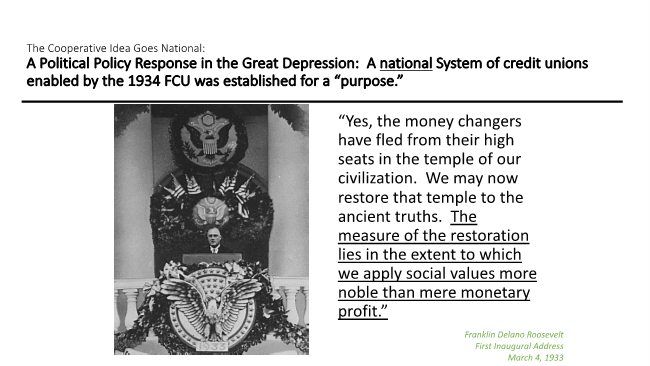
The Public Policy Role of Credit Union Cooperatives (Part 1)

Most credit union observers agree that the emergence of financial cooperatives was one outgrowth of the reform movements affecting many areas of American society at the beginning of the 20th century.

Across America, factory workers, farmers, women suffragettes, and city social workers had organized numerous initiatives and political efforts to resolve emerging problems. These initiatives responded to individual abuses and inequalities that became exacerbated during this era of monopoly capitalism converting a largely agrarian economy to an industrial one.

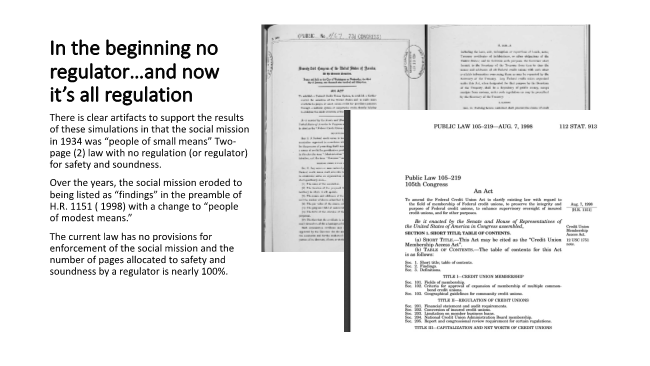
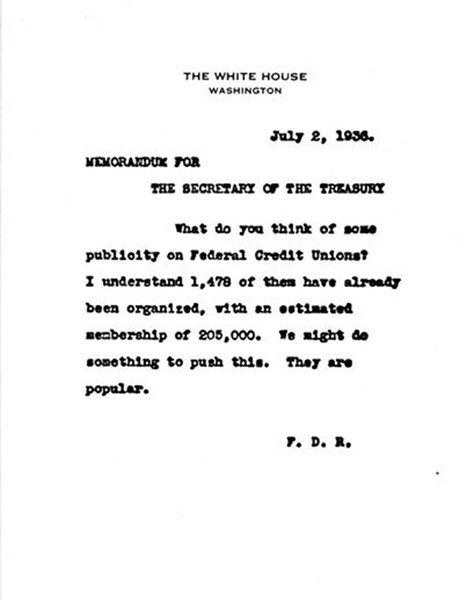
Credit unions were one of many attempts to meet the basic financial needs of ordinary people who had no access to fair financial services of any kind. This experiment begun with St. Mary’s Bank in 1909, then slowly evolved state by state over twenty-five years. These various examples became the proof of concept that resulted in the passage of the Federal Credit Union Act in 1934 as part of FDR’s new deal initiatives.

Filene and Bergengren convinced the administration and Congress that a national program for expanding consumer credit could help with recovery during the depression by increasing demand for consumer goods and services with credit.

The following slides provide snapshots of the evolution of the “movement” from social initiative to a fully formed financial system alternative for consumers. They summarize the ever changing balance between mission/purpose and institutional financial success as overseen by the federal regulator.

  1. The Need for Fair Consumer Credit

  1. Roosevelt’s support. 4,793 federal charters were issued from 1934 through 1941 when new charters fell temporarily to around 100  per year during WW II.

  1. Credit unions were first overseen by the Department of Agriculture. During WWII oversight was transferred to the FDIC. Post war, the bureau of federal credit unions became a department within HEW. In 1977 the National Credit Union Administration became an independent agency.

  1. In 1977 NCUA’s independent status began with 13,050 active federal charters. At the end of 2020 there are 3,185 active federal credit unions. Of the 24,925 federal charters granted, 92% were issued in the forty-four years prior to NCUA’s becoming an independent regulatory agency. Under NCUA the balance between mission/purpose and economic performance has increasingly focused on financial performance.

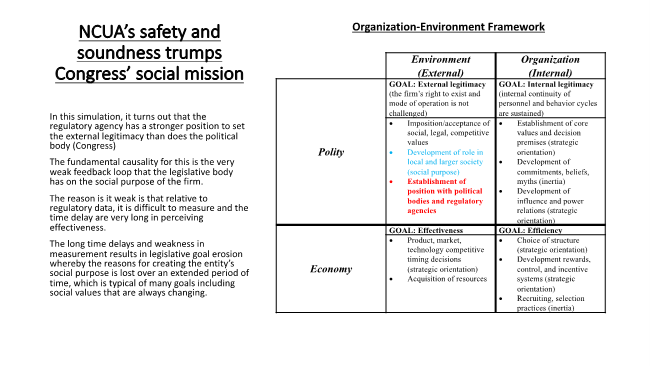
  1. Today NCUA’s safety and soundness measures dominate cooperative oversight.

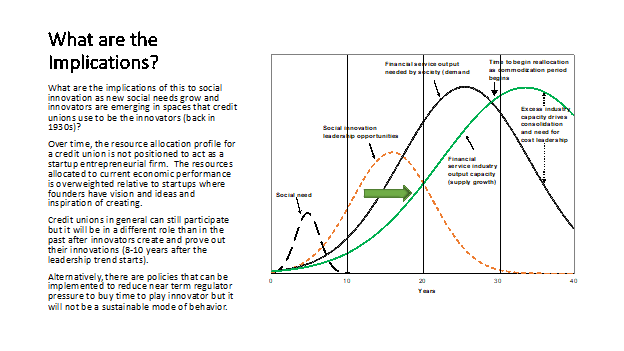
  1. The absence of new charters has stifled entrants with innovative ideas. The industry has consolidated and become more homogeneous in business strategy.

Slides: 3-6 are by Steve Hennigan, CEO of Credit Human FCU using feedback loop analysis.

The traditional view of credit union’s special role justifying their tax exemption has three bases: their cooperative, member-owned structure, the legislative intent to serve people left behind by existing financial options, and the field of membership-common bond-requirement.

As the cooperative business model has evolved, so has the concept of purpose and credit union’s role in their communities. Today member’s financial health is an animating concept for some. Other credit unions continue emphasis on superior service, better value, and member relationships.

Consumer financial services are now available from multiple providers. Credit union’s success confirmed that consumer lending is an attractive business opportunity for banks and other start up firms. Today many financial options and new entrants, from payday lenders to online lending startups, target consumers.

More than a Business Model–A Design Advantage

The founding pioneers of credit unions did more than prove out a new business segment with consumers. The cooperative model was one in which people:

  • Found a solution by working together;
  • Identified common challenges to organize and solve it themselves;
  • Prioritized mutual needs overcoming fears that they couldn’t succeed;
  • Created a community and bond that formed relationships to sustain efforts;
  • Accomplished something they had never done before to get something they didn’t have.

Cooperative purpose established these core traditions that are the foundation for continuing credit union relevance and uniqueness in an ever-changing economy.

The question is, if credit unions did not exist, would we create them today? What needs would they serve? Is purchasing the assets and liabilities of banks, consistent with the credit union cooperative role?


Do Small Credit Unions Matter?  Should They?  Will They?

In March 2014 before Jim Blaine laid down his sword, err pen, he wrote about the demise of small credit unions.  In the blog Clubbing Baby Seals, he used numbers to describe this decline concluding: “We’re in the midst of a “CU ecological” meltdown.” And the cooperative climate has only gotten hotter since.

The Less than $10 Million Segment Trends

The starting point in Jim’s analysis was ten years earlier in 2004 when there were 4,255 credit unions under $10 million.  At his writing, the total had fallen by half.  I updated his numbers for the most recent decade, 2010 through 2020, which show a continuing decline of the under $10 million segment from 2,908 (41% of cu’s) to 1,179 (23% of cu’s)—a 60% drop.

Many would react to these trends with a shrug: “They are what they are. This is just the marketplace at work.  These credit unions often underperform industry averages, do not provide a wide range of services, and members can find better deals elsewhere.  Besides larger credit unions continue to add members and grow. These organizations are not significant to carrying out the cooperative mission.”

Why Credit Unions Should Be Concerned With this Trend

This trend matters because of its impact on the system’s future  in two respects.

  1. All credit unions start small. Every credit union operating today was organized with assets in the hundreds or thousands of dollars.  From these small seeds large oaks can grow.  While all credit unions under $100 million show declines in charter numbers, segments above this amount have added 351 to their number in the same decade.  All emerged from the smaller asset segments. For the largest category, greater than $1 billion in assets, the count has gone from 167 in 2010, to more than 375 today.  Without seeds, the system will eventually run out of crops to harvest.
  2. The traditional interpretation of the decline is incomplete. Credit unions from the very beginning have started and then faltered.  Most that do not sustain operations are small.  Since FOM changes in the 1980’s, the vast majority of closed charters merge with other credit unions.

In 1978 when NCUA published the ratio for the FCU survival rate–number of active charters divided by number of charters issued–the percentage was 55%.   That was after 44 years of operations.

Today that ratio is 13%. (3,185 active/24,925 FCU’s chartered).  However, the reason for this dramatic decline in sustainability is not that small credit unions cannot survive.

The Federal Regulator’s About Face

In every year beginning in 1934 (except three war years) until 1971, the number of new FCU charters granted always exceeded the number cancelled.  In that year, FCU’s were required to qualify for NCUSIF insurance.  In 1978 NCUA became an independent agency.

In the same length of 44 years of NCUA’s oversight, the number of cancelled charters has exceeded new startups every year.  The loss of just federal charters during NCUA’s  tenure as an independent agency totals 9,865—from 13,050 (in 1978) to 3,185 (2020).

The primary reason for the decline of almost 10,000 active federal credit unions is that new charters have become virtually impossible to attain. They have averaged fewer than 10 per year in this century, and only 2.5 in the last decade.

The possibility for groups of citizens to form and control their own democratically governed financial entity has been effectively extinguished by the very organization charged with overseeing the cooperative system’s safety and soundness.

So What?

With new entrants effectively turned away, the industry’s structure will inevitably become more  consolidated in much larger credit unions. The diversity in credit union charter size is being eliminated.

Some would opine, “so what?”   Members continue to join, and the industry is financially strong and independent of sponsors. This is the natural outcome of any business in a competitive market economy.

Punching Above Their Weight

Blaine’s concern about the demise of smaller credit unions was summarized as:  Small credit unions “punch well above their weight” in terms of member impact and community importance.  Every credit union was created for a purpose, rarely did that original purpose have anything to do with ‘growth’”. 

He calls out the organizing motivations for a cooperative charter: persons with a common interest getting together to improve their local circumstances and opportunity.  Members then and today care most about the service they receive.

A credit union’s asset ranking, number of branches, surcharge free ATM’s or even its multiple channels do not create loyalty if an institution cannot respond to individual and local circumstances. That is the key factor in small credit union success.

The Democratization of Financial Opportunity

Credit unions’ democratic character was created from a fabric of relationships and community support.  These local origins were their source of political support.  Even though banks have opposed credit unions from the beginning, they have been unable to block their efforts to expand member services.

“Punching above their weight” is illustrated most recently by the quickness of Congress to overturn the Supreme Court’s interpretation of the Federal Credit Union act in 1998 limiting common bond to a single group.  In just months, the Credit Union Membership Access Act was passed approving the  field of membership interpretation NCUA authored in 1983.

But that success was over two decades ago.  Do credit unions conceived  in earlier eras still have the same political weight today?  Have the growth ambitions of some  via “voluntary” mergers and bank purchases raised issues of both member and public support for a less distinctive cooperative charter?

Can Small be Big Again?

I do not know what the future will bring.   Will ever-larger credit unions be increasingly viewed as just another impersonal financial option, like a bank?  Will the tax exemption survive the expansions of markets and scattering of local attention and knowledge?

Will the goodwill so critical in any industry’s ongoing success wither away as the seed corn for its future is no longer replenished? Or will credit union leaders see this declining trend as a priority and provide support comparable to the $100 million goal of CUNA’s Open Your Eyes marketing campaign?

Renewal efforts are underway. Can the initiatives to repurpose charters with new human capital be proven out?  Will the efforts to create more service center options via CUSO’s succeed?  Can the charter process be assigned to the regions so applicants are supported positively and quickly?

Two factors suggest this trend can be addressed.  The places of economic disparities and need are as numerous now as any time in our history.  The human spirit of solving problems and the values of cooperatives align with many seeking to bring change for a more equitable America.


Two Reflections from Memorial Day

Opposition to the Vietnam war on many college campuses led to the cancellation of ROTC programs.  Subsequently the draft was ended with all branches of the military now relying on volunteers to fill their ranks.

One observer commented on the fewer ROTC programs and the elimination of the draft as incentives for college graduates to serve in an all-volunteer military.  He foresaw a possible outcome as follows:  Societies fall to folly when they draw distinct lines between their warriors and scholars. What this ultimately leads to is society’s thinking done by cowards and its fighting done by fools. 

What if we are called to serve and fail to answer?

The heydays of credit union charters began in the Great Depression with passage of the Federal Credit Union Act in 1934.   Post WWII saw another upsurge in new chartering activity.  From 1949-1970 between 500-700 new FCU charters were issued per year.

By yearend 1978, when NCUA became an independent agency, 23,278 federal charters had been granted of which 12,769 (55%) were still operating.

Many factors affected this chartering explosion.   One was the social ethic of the Greatest Generation.  The cooperative values of self-help, local leadership and community service were closely aligned with the ethos of the generation forged by depression and world war.

Some writers believe this capacity for social responsibility has been superseded in current generations by a more individualistic focus,  personal independence  and financial success.

A guest editorial by Margaret Renkl on this change of values was published Memorial Day, May 31, 2021 in the New York Times.

My question is whether this attitude might contribute to the virtual absence of new charters in this century.   There have been 193 FCU’s in first 20 years of this century, or fewer than 10 per year.  Here are several excerpts of the writer’s thinking:

“Young men of my father’s generation grew up during wartime and generally expected to serve when their turn came. No generation since has felt the same way. There are compelling reasons for that shift — the protracted catastrophe in Vietnam not least — but I’m less interested in why it happened than in what it tells us about our country now. What does it mean to live in a nation with no expectation for national service? With no close-hand experience of national sacrifice? . . .

 The need for some nonmartial way to nurture communitarian qualities is more urgent now than ever. We have lately been reminded of the absolute necessity for Americans to be motivated by warm fellow feeling across divides of region, race, class, politics, religion, age, gender, or ability; to cultivate a sense of common purpose; to make sacrifices for the sake of others. And that reminder came in the form of watching what happens when such qualities are absent, even anathema, in whole regions of the country. . .

If Vietnam exploded the unquestioned commitment to national service, the coronavirus pandemic should have been the very thing to bring it back.

That it did exactly the opposite tells us something about who we are as human beings, and who we are as a nation. There is more to mourn today than I ever understood before.” 

The Question for Credit Unions

To the extent that our society has lost capacity to “nurture its communitarian” responsibilities, how does this affect the cooperative model?  Credit unions rely on volunteers. Their greatest strength is the fabric of relationships they cultivate with members and their communities.   Has the model lost its way as a new generation of leaders takes control without a link or even knowledge of the qualities that created the institutions they inherit?

Have credit unions abandoned their capacity to cultivate a sense of common purpose; to make sacrifices for the sake of others now that they have achieved financial sufficiency and can stand apart from their roots?

Is credit union leadership today susceptible to the social folly described by the first writer?

Just a Coincidence?

Two news reports in one day on credit union failures suggest these events are merely different sides of the same coin.

First Story: 

ALEXANDRIA, Va. (May 24, 2021) – “The National Credit Union Administration today placed Empire Financial Federal Credit Union in Jackson, New Jersey, into conservatorship.

Empire Financial Federal Credit Union is a federally insured credit union with 343 members and assets of more than $3.04 million, according to the credit union’s most recent Call Report. Empire Financial Federal Credit Union serves multiple faith, occupational, and associational groups, and communities primarily located in New York, New York, and New Jersey.”

Second Story:

Former CU Service Center Co-founder Sentenced for $1M Embezzlement   By Peter Strozniak, Credit Union Times

“Joan Brown stole funds to keep her business and the six CUs it served afloat, prosecutors and defense lawyer say. . .

Starting in 2010 and through 2016, Brown embezzled more than $1 million, which was drawn on accounts of Cardozo Lodge FCU; O.P.S. Employees FCU; Chester Upland School Employees FCU; Triangle Interests FCU; Electrical Inspectors FCU and Servco FCU.”

NCUA liquidated all six credit unions in April 2016.

The Same Coin

These two events, I believe, are related.   The failure of six credit unions resulted from an embezzlement conducted over six years.   Six times six means that examiners had 36 chances to discover wrongdoing.

By moving Empire Financial FCU’s office 77 miles away to the main office of Municipal Credit Union, still in conservatorship, means a forced merger is underway.  Any doubt there might have been fraud in this case as well?

These repeated  credit union failures due to embezzlements that occurring  over years or for decades in the case of CBS Employees FCU, suggest that examiners  are either inadequately trained or just not up to the job of conducting routine reviews of general ledger activity and the accounts of key personnel.

In small credit unions with only one or two employees these reviews are straight forward and critical because there is little or no separation of duties.

The coin involved is the same: the members’ money in direct losses or via NCUSIF liquidations.

Hiding Shortcomings

The lack of transparency around these events enables NCUA to hide internal shortcomings until the facts are revealed in court cases years later-five  in the Times example above.  Post examination reviews are either not done because of the small amounts involved or the problem has been “resolved,” that is merged or liquidated.

The temptation for money handlers to commit fraud is endemic with the role.  That is why field exam contacts are necessary.   Simple audit steps and verifications help keep honest people honest.

These coincidental events suggest something is lacking in NCUA’s oversight of its smallest institutions. If shortcomings exist in this segment, one must wonder about examinations of larger, more complex credit unions whose activities include buying banks and purchasing other credit unions.

Is NCUA’s exam program up to the job whether the credit union be small or large?   Whether the review is simply balancing clearing accounts or complicated, such as using derivatives to mitigate risk?

Someone at the agency needs to own this challenge.  The first step would be to bring light to these failures as they occur, not in legal proceedings years later.  That public comment would put the agency’s examiners, credit unions and dishonest employees on notice that NCUA is alert for bad actors.


The NCUA Board’s Emerging Redesign

Since Todd Harper moved from a minority board member to chair in February, board members have become more vital in overseeing agency activities.  Their increasing dialogue and comments at public meetings, if followed through, could be a harbinger of greater NCUA accountability to the credit union system.

In theory, the board should be the true point of connection with, and representative of, the best interests of credit unions and their members.  In practice, chairman of different backgrounds, parties and ambitions have acted as the sole leader for the agency.  Some have openly stated and/or acted as though credit unions have no role in the agency’s spending, its problem solving, or its management priorities.

Some non-chair members have occasionally treated their status as a part time job, a public sinecure requiring only visibility at board meetings, like credit union volunteer directors.  That does not seem to be the case now.

Three Diverse Backgrounds

The opportunity for a more vibrant, effective board comes from the very different experiences of each member.

Kyle Hauptman, vice chairman is the newcomer and “outsider.”  No credit union background, a professional career in finance, he brings the ability to see the industry from an objective point of view.  To become a quick learner, his first decision was to find a senior advisor who had a deep knowledge of credit unions from outside NCUA and government.

Chairman Harper is the “insider.” He describes himself as the first NCUA staff person appointed to the board having served as Chairman Matz Senior Policy advisor and PACA director from 2011-2017.  He references his time as a hill staffer working on financial legislation and draws parallels with FDIC to support his views. Although his term has expired, he continues in place until his successor is appointed.

The board “veteran” is Rodney Hood who served on the NCUA board from 2005-2009 and was reappointed by President Trump again in 2019.  His positions are influenced by the priorities he promoted as Chairman from 2019 through January 2021.  However, as he is no longer in that priority setting role, his perspective from his earlier tenure seems to increasingly inform his approach.

The Signs of Change

Board decisions are usually determined in advance, or else not placed on the agenda.   Therefore, the discussion around reports, the dialogue with staff and the comments related to the agenda become more informative than formal policy votes.

The “Veteran”

For example, Hood has presented statements about his focus going forward.   He has used the phrase “evidence based” judgments versus relying on forecasts of future “facts.”   In reference to the corporate crisis which broke in his first tenure, he cited the virtue of “patience” as an important lesson when making consequential decisions in uncertainty.

He has commented on the agency’s management of the level of cash in the operating fund:

I will be asking tough–albeit fair– questions about the Operating Fund carryover balance

In my view, his most consequential statement in the May board meeting came during the request for credit union comments on the NOL level in the NCUSIF.  His words:

Again, Mr. Chairman, we must recognize that our model is a very different premium model than the FDIC’s model.  Credit unions are legally committed and bound to update a large majority of the fund’s equity contribution. Credit unions today provide the bulk of the capital contributions that are the basis of the fund’s soundness.  It’s a cooperative insurance system that we run at the NCUA.

This was a statement that every credit union would agree with. The fact is that credit unions legally stand behind the fund, not the government. More importantly it came during a week in which the chairman had endorsed legislation to change the NCUSIF’s cooperative model to be more like the FDIC.

The “Outsider”

Kyle Hauptman presents his topics in a more Socratic dialogue with staff. Several meetings ago, he referenced discussions during a credit union meeting indicating credit unions felt inhibited about critiquing examiner conduct.   He asked if it were proper for credit unions to record their meetings.  Staff waffled.   He then opined he thought it would be OK.

From his first board meeting he repeated his view that the agency is spending members’ money.  That NCUA has a fiduciary responsibility for these funds and should not be holding excess balances that credit unions can use more effectively making loans.  He stated the regulator should not have an “itchy trigger finger” when it comes to making decisions costing credit unions.

He has requested staff to enhance communication of board decisions with credit unions, preferably on the website.  One example was the process for distributing dividends from the AME surplus; and in May, how credit unions can present their views on the proper level for the NOL.

Perhaps the most heartening discussion in May was on the seemingly arcane rule for derivatives.  The back and forth with staff on the role of derivatives and later, on the changing reference rate for LIBOR, demonstrated a knowledge of financial markets that is very rare at the board.

The “Insider”

Chairman Harper has continued to put forward his views while at the same time affirming some of the comments of his fellow board members.  He supported a “look back” to assess the agency’s management of the corporate crisis.   He concurred with Hood’s description of the NCUSIF as a cooperative fund.  There appears to be no opposition to increased director reliance on actual facts versus that is the way we have always done it; for historical evidence versus hypothetical models.

His challenge is whether he can move on from his tenure with  Chairman Matz when she declared that “credit unions did not represent their members,” had “no interest in the agency’s budget,” and that as an independent agency, it “was not good government for the people who are regulated trying to participate in the budget making process of the regulator.”

The Big Test Coming Up

The most important issue on the horizon is how the board will respond to the comments submitted by credit unions on the maximum level of the NOL in the NCUSIF.

That cap now is 1.38, a result of decisions made in 2017 when the TCCUSF fund was merged with the NCUSIF.  From then till today, is the first time in the history of the fund, that the NOL has been set above 1.3% of insured shares.

This 2017 decision was preceded by a request for comments on the board’s merger proposal.  The two-person board received 663 comments during the 45 days provided.  The NCUA staff stated in its summary of comments that only 12 credit unions appeared to support the agency’s plan.  That is 98% were opposed.

A focus of the critiques was the false modeling to justify the NOL increase to 1.39%.   Credit unions universally opposed this action, yet NCUA changed not a thing from the original proposal.  Credit unions spoke, but NCUA did not listen.  Even when presented with facts that contradicted the agency’s financial assumptions.

A long analysis of this event is reported in Time for Real Credit Union Disruption.

Unity, Not Uniformity

Unity is not the same as uniformity. NCUA board members have different competencies and points of view.  Unity relies on reconciliation of differences, not giving them up. This is done by uniting around what is held in common. Hopefully, that core is deciding for the best interests of credit unions and their members, not NCUA, or even a specific political philosophy.

A pragmatic, fact-based approach can create unity for the NCUA board’s most critical decisions.  That could transform the board into  a true asset for credit unions that continues to appreciate not diminish in value.